
Winkler County, TX — August 3, 2025, Areal Casanas was killed and Teodricke Miller and Raheem Griffin were injured in a multi-vehicle truck accident at approximately 6:00 a.m. along S.H. 115.
According to authorities, 24-year-old Teodricke Miller was traveling in a northbound GMC Acadia and 26-year-old Raheem Griffin was traveling in a northbound Ford F-350 on State Highway 115 in the vicinity of County Road 302 when the accident took place.
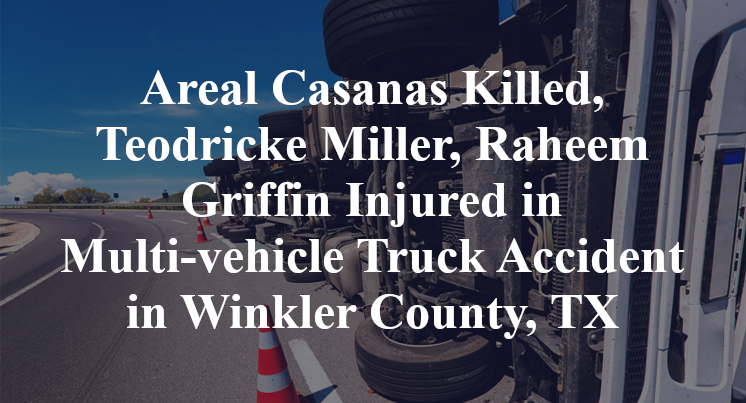
Officials indicate that, for as yet unknown reasons, as the Acadia was slowing in order to make a left turn onto C.R. 302, it was rear-ended by the Ford. The impact apparently caused the Acadia to crash into a barrow ditch and catch on fire. Reports state that the Ford pickup truck, which had become disabled in the roadway, was then struck by a southbound Freightliner Cascadia occupied by 48-year-old Areal Casanas. The Freightliner overturned over the course of the accident, according to reports.
Casanas reportedly sustained fatal injuries over the course of the accident. Griffin suffered serious injuries and Miller received minor injuries due to the wreck; they were each taken to local medical facilities by EMS for treatment. Additional details pertaining to this incident are not available at this point in time. The investigation is currently ongoing.
Commentary by Attorney Michael Grossman
When a chain-reaction crash leads to the death of a truck driver who likely had no warning of the hazard ahead, it’s important to look closely at how that hazard came to be—and whether it could have been avoided. Based on the initial reports, the key question here is how a routine left turn set off a sequence that left one vehicle in flames, another disabled in the road, and a third overturned with a life lost.
The first link in that chain appears to be the Ford rear-ending the Acadia as it slowed to turn. Whether that was due to inattention, speed, or following too closely is not yet clear, but in my experience, rear-end collisions at low speeds usually come down to a lack of situational awareness. If the Ford hadn’t struck the Acadia, the rest of the crash likely doesn’t happen.
But what makes this crash especially dangerous is what happened next: the Ford was left disabled in the roadway. At that hour—just after sunrise—a commercial driver heading the other way may have had little time to react. That’s especially true on rural highways where speeds are high and sightlines are limited. If the disabled vehicle didn’t have hazard lights activated or wasn’t visible in time, even a cautious driver in a fully functional rig might not have been able to avoid it.
These kinds of secondary collisions are often the deadliest part of a multi-vehicle crash. I’ve handled cases where an initial crash created a hazard that others couldn’t avoid, and the legal question became whether the person who caused the first crash—and the companies behind them—should have foreseen that risk. In those cases, liability extended beyond just the first impact to the full chain of consequences.
Key Takeaways:
- The initial rear-end collision appears to have triggered a dangerous chain reaction that led to a fatality.
- The visibility and positioning of the disabled Ford truck will be critical to understanding whether the Freightliner driver had time to react.
- Investigators should examine lighting conditions, hazard warnings, and whether the trucker had any realistic opportunity to avoid the crash.
- Rear-end liability and the foreseeability of secondary impacts are both likely to be key legal issues.
- A thorough analysis must follow the sequence of events from the first collision to the final outcome to assign responsibility accurately.

 call us
  Email Us
  Text us