
Collier County, FL — June 12, 2025, One person was killed following a dump truck accident that occurred Thursday morning on Corkscrew Rd.
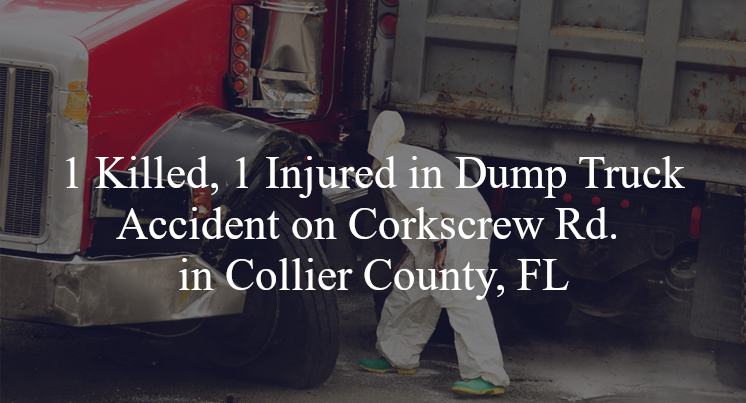
According to official statements, a dump truck and a passenger vehicle accident occurred on Corkscrew Road near Whidden Loop Road, though the circumstances that caused the crash are not yet clear.
First responders arrived transported two people from the passenger vehicle to the hospital where one was later pronounced deceased, and the status of the other occupant has not been released, neither has their identities. This incident remains under investigation and more details may be released in the future.
Commentary by Attorney Michael Grossman
When a passenger vehicle collides with a dump truck, especially with fatal results, the public deserves more than just the basic outline of events. According to reports, the crash happened on Corkscrew Road near Whidden Loop Road, but how or why it happened hasn’t been explained. That leaves a major question hanging in the air: What led up to this collision?
What We Don’t Know Yet
Right now, there’s no indication of whether the dump truck was moving, stopped, turning, or pulling out of a side road. We don’t know whether the passenger vehicle was trying to pass, follow, or avoid it. Those details make all the difference when trying to understand who might be at fault—or whether this crash was preventable.
Depending on whether the truck was turning across traffic, backing up, or stopped in a lane, very different legal and safety questions come into play. For instance, dump trucks often have significant blind spots and wide turning paths. If the driver failed to yield, didn’t use mirrors properly, or made an unsafe maneuver, that could be a factor. But without more detail, we simply don’t know.
What the Investigation Should Focus On
A proper investigation will look at physical evidence from the crash site—brake marks, point of impact, road conditions—as well as electronic data from the dump truck. Many commercial vehicles are equipped with an engine control module (ECM) that can provide information about speed, braking, and throttle use in the seconds before the crash. Some even have in-cab cameras that can show whether the driver was alert and in control.
Equally important is the truck’s operational record. Was it properly maintained? Was the driver working a legal number of hours? Did the company that owns the truck follow basic safety and hiring protocols?
In short, figuring out what happened doesn’t come from assumptions—it comes from data, documentation, and experience knowing what to look for.
Why These Questions Matter
When someone loses their life in a crash involving a commercial vehicle, it’s easy to chalk it up to a “terrible accident.” But in my experience, there’s usually more beneath the surface. Whether the issue was driver error, company negligence, or mechanical failure, accountability starts with a full understanding of the facts.
Key Takeaways:
- The circumstances leading to the crash between the dump truck and passenger vehicle remain unclear.
- Critical details—like whether the dump truck was moving, turning, or stopped—will help determine fault.
- Evidence such as ECM data, in-cab video, and physical damage patterns should guide the investigation.
- The role of the trucking company—from driver oversight to vehicle maintenance—must be closely examined.
- A thorough investigation is the only way to move from unanswered questions to real accountability.

 call us
  Email Us
  Text us