

Motorcyclist Injured in Garbage Truck Accident on Grass Lake Rd. near Antioch, IL
Lake County, IL — April 14, 2025, a man was injured in a motorcycle versus garbage truck accident just before 10:30 a.m. along Grass Lake Road.
According to authorities, a 35-year-old man was traveling on a motorcycle which was attempting to pass a garbage truck in the vicinity of the Grass Lake Road and West Parke Avenue intersection when the accident took place.
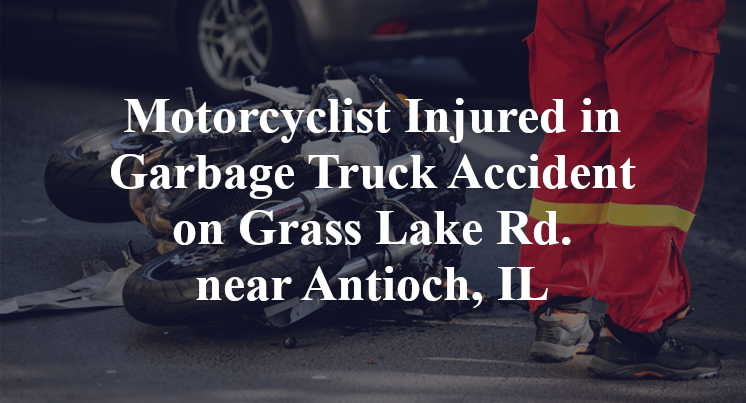
Officials indicate that, as the motorcycle was attempting to pass the garbage truck on the left, the truck instigated a left turn, resulting in a collision between the two vehicles. The motorcyclist reportedly suffered serious injuries due to the wreck. Additional details pertaining to this incident—including the identity of the victim—are not available at this point in time. The investigation is currently ongoing.
Commentary by Attorney Michael Grossman
In my experience, crashes between motorcycles and large service vehicles like garbage trucks often turn on a single moment of miscommunication—or more precisely, a failure to communicate at all. When one vehicle attempts to pass while the other initiates a turn, the outcome is almost always serious, and in cases like this, the responsibility to prevent that outcome lies heavily on the shoulders of the professional driver.
Garbage trucks operate differently from most vehicles on the road. They make frequent stops, turn in and out of driveways, and often follow irregular patterns through residential and mixed-use areas. That’s exactly why operators of these vehicles are expected to drive with heightened awareness, especially when it comes to blind spots and signaling turns. If the driver in this case turned left while a motorcycle was already attempting to pass, the question becomes whether the turn signal was activated and visible—and whether the driver checked their mirrors and surroundings before initiating the move.
Motorcyclists are especially vulnerable in these situations. Even when riding lawfully and with caution, they’re often harder to see, and they have far less protection in the event of a collision. That’s why professional drivers are trained not just to follow the rules of the road, but to anticipate and avoid these types of conflicts whenever possible. If the truck driver failed to do that, it may not just be a momentary lapse—it could be a sign of insufficient training or a company policy that prioritizes efficiency over safety.
If the garbage truck was operating under a municipal contract or private waste management company, the investigation should also include a close look at the organization’s safety practices. Was the driver trained to handle interactions with smaller, more agile vehicles like motorcycles? Were they familiar with the area and the expected traffic patterns? Was the truck equipped with mirrors, cameras, or sensors designed to reduce blind spots and detect passing vehicles? These are all preventable risk factors that have come up again and again in cases I’ve handled.
From where I sit, a crash like this isn’t just about who turned when. It’s about whether the driver of a large, potentially hazardous vehicle took every reasonable step to avoid a collision with a vulnerable road user. A full investigation should answer that question—because only then can the right parties be held accountable and those affected by the wreck receive the clarity and closure they deserve.
“These are essential reads for anyone dealing with the aftermath of a truck wreck”– Attorney Cory Carlson