

2 Killed in Truck Accident on Hwy. N in Cold Spring, WI
Jefferson County, WI — September 17, 2025, two people were killed due to a truck accident sometime in the afternoon along Highway N.
According to authorities, two people were traveling in a southbound SUV on County Road N in the vicinity of the Carnes Road intersection when the accident took place.
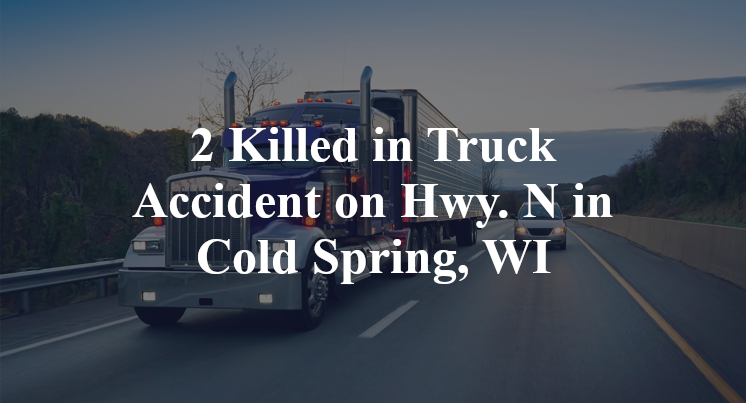
Officials indicate that, for as yet unknown reasons, a northbound 18-wheeler failed to safely maintain its lane of travel. It apparently veered right, temporarily entering the gravel shoulder before being overcorrected to the left; it subsequently entered the southbound lane of the roadway. Despite the SUV's attempt to swerve into the shoulder and avoid a collision, a crash still took place between the 18-wheeler's trailer and the SUV.
The two occupants of the SUV were reportedly entrapped in the wreckage and had to be extricated by emergency personnel. Once freed from the aftermath, life-saving measures were attempted on both victims, but were unsuccessful; both the driver and the passenger of the SUV were declared deceased at the scene.
Additional details pertaining to this incident—including the identities of the victims—are not available at this point in time. The investigation is currently ongoing.
Commentary by Attorney Michael Grossman
When a large commercial truck ends up in the wrong lane and a crash follows, the most urgent question becomes: Why did the truck leave its lane in the first place? That’s not a minor detail—it’s the foundation for determining responsibility, and right now, that answer hasn’t been made public.
One possible explanation is driver error: drifting off the road and overcorrecting is something that can happen if the driver is fatigued, distracted, or not properly trained to recover from a shoulder departure. But without hard evidence, even that remains speculation. The key is whether anyone’s asking the right questions—and securing the right data—before that evidence disappears.
Modern trucks often carry engine control modules that can tell us whether the driver was braking, accelerating, or steering erratically in the moments before the crash. If that information is preserved, it can confirm or contradict any claims about how the vehicle ended up off course. Dash cams, if installed, can provide even more clarity—especially in cases where the driver’s version of events doesn’t match the physical evidence.
But driver behavior is only one layer. There’s also the matter of how well the company managed the person behind the wheel. Was the driver properly screened? Was this a long shift, pushing up against hours-of-service limits? Was the driver trained to handle a recovery if the truck left the roadway? These aren’t side issues—they go directly to whether the crash was the result of one bad decision, or a system that allowed a dangerous situation to unfold.
It’s also important to note that when a passenger vehicle tries to avoid a collision but still can’t, that usually tells us something about how much time—or space—was available to react. That speaks not just to what happened in the final seconds, but to how far things had already gone wrong by the time the crash became inevitable.
Key Takeaways
- The reason for the truck’s departure from its lane remains unknown, but is central to determining fault.
- Black box and dash cam data may confirm how the truck was being operated before and during the incident.
- Driver fatigue, distraction, or inadequate training could all be relevant depending on what the evidence shows.
- The trucking company’s hiring and oversight practices must be examined as part of the investigation.
- A full and timely investigation is necessary to prevent assumptions from standing in place of accountability.
*We appreciate your feedback and welcome anyone to comment on our blog entries, however all visitor blog comments must be approved by the site moderator prior to showing live on the site. By submitting a blog comment you acknowledge that your post may appear live on the site for any visitors to see, pending moderator approval. The operators of this site are not responsible for the accuracy or content of the comments made by site visitors. By submitting a comment, blog post, or email to this site you acknowledge that you may receive a response with regard to your questions or concerns. If you contact Grossman Law Offices using this online form, your message will not create an attorney-client relationship and will not necessarily be treated as privileged or confidential! You should not send sensitive or confidential information via the Internet. Since the Internet is not necessarily a secure environment, it is not possible to ensure that your message sent via the Internet might be kept secure and confidential. When you fill out a contact or comment form, send us an email directly, initiate a chat session or call us, you acknowledge we may use your contact information to communicate with you in the future for marketing purposes, but such marketing will always be done in an ethical way.